



Check for leaks
One little leak can turn into a whole lot of water and money. You could save bucket loads on your water usage by checking for leaks or updating your contact details to get leak alerts.
On this page
Get leak alerts: Make sure we have your up-to-date mobile and email to receive leak alerts promptly. Sign in or register.
I might have a leak, how do I find it?
Leaks aren’t always easy to see, and continuously flowing water may not always be a leak. These are the most common culprits.
Toilets
A leaky toilet can really add up. A trickle can add more than $425 a year to your bill, while a big leak could add $3,000 or more. A good way to check if your toilet is leaking is the paper test.
Follow these steps to check:
- Place a piece of toilet paper at the back of the toilet bowl.
- Make sure the back of the toilet pan is dry (best to wait 30 mins after the last flush).
- Leave it there for a few minutes (make sure no one uses the toilet during this time).
- If the paper is wet or torn, you may have a leak.
Please note a toilet can also leak from the base if the seal is broken.
Taps
Dripping taps or a tap that is accidentally left on might not seem like a big deal, but they can waste up to 20,000 litres of water per year or 55 litres a day, that’s roughly $25 extra each bill. If you notice a tap dripping, the most likely cause is a worn washer, which you may be able to replace yourself or get a plumber.
Irrigation systems
Both unexplained wet patches in your lawn or garden or some areas which are greener or growing faster, can indicate a fault or leak with your irrigation system.
Evaporative coolers
Large, ducted units are located on rooftops, smaller ones are by doors or windows. It’s normal for a small amount of water to drip from the pipe when in use. But if you see water running down the roof even when the system is turned off, or a wet patch appears on an internal ceiling or wall, you may have a leak.
Hot water units
The most common problem with hot water systems is the Pressure Temperature Relief Valve (PTRV) malfunctioning and releasing water. In older systems, this can lead to dangerous pressure build-up, which may cause the unit to fail or rupture.
As hot water systems are generally located on the side of a house, where people normally don’t walk these leaks can go undetected for ages. To check for a leak, simply find your hot water unit and see if there is water running out of the pipe. Not having any hot water in the home is another indicator.
Faulty automatic top-ups for your water tank or swimming pool
These can malfunction and overflow without you even knowing it. It's a good idea to check these regularly to make sure they're working properly and not wasting precious water.
If you’ve checked and can't find a source for the leak, it may be that there is a leak under the house or garden.
What to do:
- Contact a licensed plumber as soon as possible to investigate and repair the issue.
- While waiting for repairs, if possible, turn off your water supply at the stop tap near your meter and only turn it back on when needed. This will help minimise water loss and costs.
Verify if you have a leak
- Find your water meter
- Stop using any water
- Wait for 20 minutes
- Check your meter again
If you live in a house, your meter is outside and usually near the front gate or fence. For units and apartments, your meter is connected to the main water meter and it may be near your front door or in a service cupboard. If you're not sure where your meter is, contact your building management or your owner's corporation.
Once you’ve found your meter, make a note of the numbers.
If you are unsure, learn how to read your meter here.
Turn off all taps and appliances except the stop tap next to the water meter and the toilet.
Just make sure no one uses any water during that time.
If the numbers on your water meter have changed or the wheel has moved, you may have a leak. Repeat the test again, just to make sure.
Not sure what type of meter you have? Learn more about your meter and how to read it.
What should I do if I have a water leak?
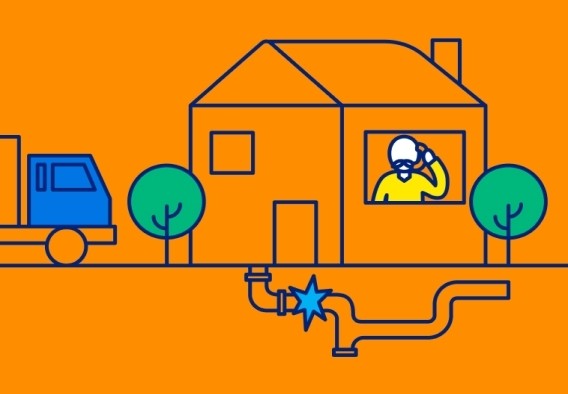
If you can't locate the leak, you may have a break in your water pipes. What to do next depends where the leak’s coming from. Take a look at the visual below to find out who's responsible for leaks.
If the leak is on your side of the meter, you’ll need to arrange for it to be repaired. The property owner is responsible for maintaining and repairing pipes from the water meter to the customer's house (including any issues with your garden tap).
For meters in unit blocks (check meters), South East Water is only responsible for the physical meter and does not maintain the pipes or stop taps on these meters or networks. Please contact your owners corporation to address these leaks.
If you notice a leak on South East Water’s side of the meter, let us know by reporting it.
I've fixed the leak, what can I do about my high bill?
If you’ve received a higher than expected water bill due to a leak, South East Water may be able to review your account under the Guideline for Unexplained High Usage and Undetected Leak Enquiries (HULA).
To be eligible for a High Usage Review, you must meet the following requirements:
Leak has been repaired
- The leak was repaired within 2 weeks of you being notified of or identifying the leak.
Your High Usage Review request was received by South East Water within 90 days of either:
- You receiving a notification from South East Water about unusual or high usage at your property, or
- The due date of the bill that shows the increased water usage.
No recent review
- You have not received a High Usage Review from South East Water at this property within the past 5 years.
What you need to provide:
To request a review, please email the following to usage@sew.com.au:
- A copy of the plumber’s report confirming the leak and repair.
- A photo of the current water meter reading.
Next steps
Once we receive your request, we’ll review your application and contact you with the outcome within 10 business days.
There’s no need to follow up during this time - we’ll reach out if any additional information is needed.